Cape Eluanbi
Southernmost point of Taiwan, site of a historic fortified lighthouse.

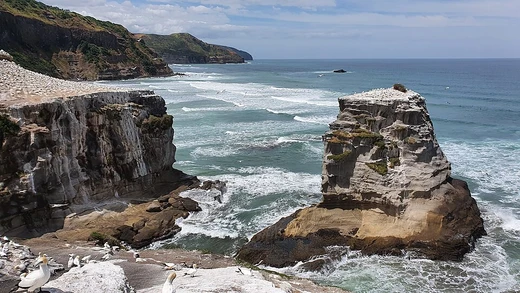
Cape Eluanbi, also known as Oluanpi Park (鹅鑾鼻公園), is located at the southernmost point of the Taiwan island. It is part of Kenting National Park, Taiwan's oldest national park, established on 1 January 1984. The cape is home to the Eluanbi Lighthouse, completed in 1883, which is one of the rare examples in the world of a fortified lighthouse. The park hosts rich terrestrial biodiversity, including 26 species of land crabs, the highest diversity of terrestrial crabs in single areas in the world.
- location
- Southernmost point of Taiwan Island, Hengchun Peninsula, Pingtung County
- also_known_as
- Oluanpi
- notable_feature
- Eluanbi Lighthouse, completed in 1883
Verified Timeline
Lore & Background
The Eluanbi Lighthouse was completed in 1883, following requests from the American and Japanese governments to the Chinese government after several shipwrecks occurred in the 1860s (including the Rover incident). Chinese troops had to be sent to protect the lighthouse during construction from attacks by local tribesmen, and the lighthouse was surrounded by a fort with cannons and a ditch for protection. The lighthouse itself is 21.4 metres (70 ft) high and its light is 56.4 metres (185 ft) above the tidal high water. The light flashes every 10 seconds and its range is 27.2 nautical miles (50.4 km). The area was once a major wintering ground for sperm and baleen whales especially humpback whales that migrated into Nan Wan and Banana Bay. Japanese whaling during Japanese colonial days led to severe depletions or disappearances of whales in consequence.
Reader's Guide
Cape Eluanbi is located within Eluanbi Park, part of Kenting National Park on the Hengchun Peninsula of Pingtung County, Taiwan. The park covers about 181 square kilometres (70 mi2) of land and 152 square kilometres (59 mi2) of sea. The cape is surrounded by the Pacific Ocean, the Taiwan Strait, and the Luzon Strait. Nature reserves such as the Longkeng Ecological Protection Area protect coral reefs and virgin forest of Banana Bay and Hengchun Peninsula. 26 species of land crabs inhabit the area, which is the highest diversity of terrestrial crabs in single areas in the world. The national park is an important stopover on the migration path of the gray-faced buzzard. The lighthouse is open to the public and remains a popular tourist destination.
Did You Know?
- Eluanbi Lighthouse is one of the rare examples in the world of a fortified lighthouse, surrounded by a fort with cannons and a ditch for protection.
- The lighthouse was completed in 1883 after requests from the American and Japanese governments following shipwrecks in the 1860s, including the Rover incident.
- The area was once a major wintering ground for sperm and baleen whales, especially humpback whales, before Japanese whaling led to severe depletions.
- 26 species of land crabs inhabit the area, which is the highest diversity of terrestrial crabs in single areas in the world.
- The national park is an important stopover on the migration path of the gray-faced buzzard.
The Fortified Lighthouse of Eluanbi
The Eluanbi Lighthouse stands as one of the world's rare fortified lighthouses, a structure born from maritime tragedy. In the 1860s, a string of shipwrecks—including the notable Rover incident—prompted both the American and Japanese governments to formally petition the Chinese government for a navigational beacon at this treacherous cape. Construction was completed in 1883, but the process was far from peaceful: Chinese military troops were dispatched to guard workers against attacks by local tribesmen, and the finished lighthouse was encircled by a defensive fort equipped with cannons and a surrounding ditch. The tower itself rises 21.4 metres, with its light positioned 56.4 metres above tidal high water. It flashes at ten-second intervals and projects its beam 27.2 nautical miles across the sea. This combination of navigational purpose and military fortification makes the Eluanbi Lighthouse a singular artifact of nineteenth-century maritime diplomacy and colonial-era engineering.
A Living Archive of Biodiversity
Cape Eluanbi and the surrounding Kenting National Park shelter a staggering concentration of life. The area records 26 species of land crabs—the highest diversity of terrestrial crabs found in any single location on Earth. Among its 34 recorded terrestrial mammal species, five are locally extinct, including the Formosan clouded leopard, while four are introduced, such as the water buffalo. In a remarkable conservation milestone, Formosan sika deer, lost from the wild in 1969, were reintroduced into the park in 1994. A decade later, the critically endangered Chinese pangolin—previously assumed extinct in the region—was rediscovered here. Marine life is equally extraordinary: ocean currents nourish ecosystems home to critically endangered hawksbill turtles, bull sharks, manta rays, and whale sharks. The waters once served as a major wintering ground for humpback and sperm whales, though Japanese colonial-era whaling drove them to near-disappearance. Dugongs, possibly functionally extinct in Taiwan, were last reported in local waters in the 1950s and 1960s.
A Landscape Carved by Coral and Wind
The geography of Kenting National Park is split by the Hengchun Longitudinal Valley Plain, a long, narrow corridor of fault valleys running north to south. To the west, coral sea cliffs are fringed with living reefs, while the northern reaches rise into a dense cluster of mountains. The southern portion presents a different character: coral tablelands and foothills dominate, with limestone caves and a vast body of water known as Longluan Lake to the east. Perhaps most striking are the unique sand rivers and sand waterfalls on the eastern face of the coral tablelands, sculpted by the combined forces of wind and river flow. The park encompasses roughly 181 square kilometres of land and 152 square kilometres of sea, totaling 333 square kilometres. It sits at the very southern tip of Taiwan's main island, bordered by the Pacific Ocean, the Taiwan Strait, and the Luzon Strait. The climate is tropical monsoon, warm to hot year-round, making the sunshine and scenic coastline a defining draw for visitors.
Stage for Music, Film, and Millions of Visitors
Since 1995, the park has hosted the Spring Scream rock-band festival every March, drawing international audiences to its tropical setting. The landscape has also served as a natural film set: most of the 2008 movie Cape No. 7 was shot within the park and nearby Hengchun, and portions of Ang Lee's 2012 film Life of Pi were filmed here, not far from the director's birthplace. The park's appeal is reflected in its visitor numbers—5.84 million people came in 2016 alone. Its name, Kenting, translates to pathfinders or pioneers, a fitting label for a place that has drawn travelers for generations. Transportation links include frequent buses to Kaohsiung International Airport, Kaohsiung Railway Station, and the High Speed Rail Zuoying Station, a 2.5-hour journey. A domestic Hengchun Airport also serves the area, though flights are infrequent and often cancelled by the strong katabatic winds that sweep the peninsula.
Frequently Asked Questions
What is Cape Eluanbi?
Cape Eluanbi, also called Oluanbi or South Cape, is the southernmost tip of Taiwan Island. It occupies roughly 59 hectares of coastal land within Eluanbi Park in Hengchun Township, Pingtung County.
What is the lighthouse at Cape Eluanbi?
The Eluanbi Lighthouse is a Qing-era fortified structure that was first lit on 1 April 1883 to guide vessels along the dangerous southern waters of the island. It remains the cape's most recognizable landmark today.
What geological formations can be found at Cape Eluanbi?
The cape sits atop the Eluanbi Beds, a Pleistocene-age sequence of sand, gravel, and clay. These exposed layers document ancient coastal and marine conditions that helped shape the Hengchun Peninsula.
How far back does human habitation at Cape Eluanbi extend?
Archaeological traces indicate prehistoric occupation dating to around 3100 BC, making it one of the oldest known coastal settlements on the island. Subsequent eras layered on a Qing-era lighthouse, a Japanese whaling station, and a modern national park.
Why is Cape Eluanbi considered significant?
As Taiwan's southernmost point, it has functioned as a navigational landmark, a prehistoric home, and a site of colonial and industrial activity. Today it is preserved as a national park that protects both its geological record and its layered human history.
More in Coastal And Marine Features 1-24
Spotted an error? Know more?
This is a living reference — every entry is fact-audited, and reader corrections feed straight into our audit queue. Suggest an edit · See this site's audit record