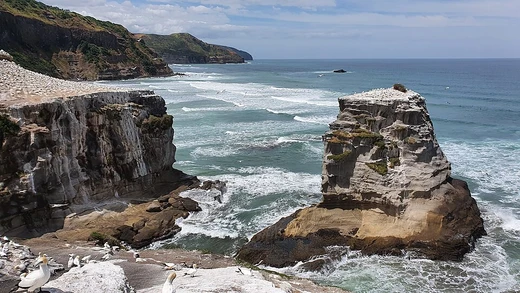
Cape Muroto
Headland in Shikoku with rapid geological uplift and cultural landmarks.

Cape Muroto (室戸岬, Muroto-misaki) is a headland at the southeastern tip of the Japanese island of Shikoku, in the city of Muroto, Kōchi Prefecture. Extending into the Pacific Ocean and situated in Muroto UNESCO Global Geopark within Muroto-Anan Kaigan Quasi-National Park, the cape has been designated a Place of Scenic Beauty and the local vegetation a Natural Monument, while the Sound of the Waves at Cape Muroto and Mikurodo Cave is among the 100 Soundscapes of Japan.
- location
- Southeastern tip of Shikoku, Japan
- designation
- Place of Scenic Beauty; Natural Monument (vegetation)
- geopark
- Muroto UNESCO Global Geopark
- park
- Muroto-Anan Kaigan Quasi-National Park
- soundscape
- Sound of the Waves at Cape Muroto and Mikurodo Cave (100 Soundscapes of Japan)
- uplift rate
- 1–2 meters per millennium
Lore & Background
On the summit overlooking the cape is Hotsumisaki-ji, the twenty-fourth temple on the Shikoku Pilgrimage, as well as Cape Muroto Lighthouse, which started operating in 1899, and a statue of Nakaoka Shintarō. Due to the subduction of the Philippine Sea Plate beneath the Eurasian Plate in the Nankai Trough, some 140 kilometres (87 mi) off the cape, the land around the cape is being uplifted at a rate of 1 metre (3 ft 3 in) to 2 metres (6 ft 7 in) per millennium, at the top end of the world's uplift rates. Birds observed in the vicinity of the cape include the osprey and blue rock thrush. Marine life in the waters offshore includes the Japanese amberjack, Japanese anchovy, Japanese barramundi, Japanese jack mackerel, Japanese mackerel, Japanese pilchard, Pacific mackerel, Blackfin seabass, three-line grunt, and spear squid.
Reader's Guide
Cape Muroto holds significance as a natural and cultural landmark in Japan. Its designation as a Place of Scenic Beauty and the protection of its local vegetation as a Natural Monument underscore its environmental value. The cape is part of the Muroto UNESCO Global Geopark and Muroto-Anan Kaigan Quasi-National Park, highlighting its geological and ecological importance. The rapid uplift rate, among the highest in the world, provides a unique site for studying tectonic processes. Culturally, the cape features Hotsumisaki-ji, a temple on the Shikoku Pilgrimage, and the historic Cape Muroto Lighthouse, operational since 1899. The sound of its waves is recognized as one of Japan's 100 Soundscapes, adding an auditory dimension to its heritage. Access is provided by Kochi Tobu Kotsu, Tokushima Bus, and the Asa Seaside Railway, which uses dual-mode vehicles on the Asatō Line, noted as the first line in the world to use this technology.
Did You Know?
- Cape Muroto is being uplifted at a rate of 1 to 2 meters per millennium, at the top end of the world's uplift rates.
- The Sound of the Waves at Cape Muroto and Mikurodo Cave is among the 100 Soundscapes of Japan.
- Cape Muroto Lighthouse started operating in 1899.
- The Asatō Line is said to be the first line in the world to use dual-mode vehicles.
- Birds observed near the cape include the osprey and blue rock thrush.
Frequently Asked Questions
What is Cape Muroto?
Cape Muroto is a prominent headland jutting into the Pacific Ocean at the southeastern extremity of Shikoku, Japan. It sits within the city of Muroto in Kōchi Prefecture and serves as a notable coastal landmark on the island.
Where exactly is Cape Muroto located?
The cape is positioned at the far southeastern tip of Shikoku, extending outward into the Pacific Ocean. Administratively it falls under the city of Muroto in Kōchi Prefecture, on the southern coast of Japan.
What official designations does Cape Muroto carry?
The headland is recognized as a Place of Scenic Beauty, while its surrounding local flora holds Natural Monument status. It also forms part of both the Muroto UNESCO Global Geopark and the Muroto-Anan Kaigan Quasi-National Park.
What is geologically special about Cape Muroto?
The cape is undergoing active tectonic uplift at a rate of roughly one to two meters per thousand years. This ongoing rise makes it a point of interest within the broader Muroto UNESCO Global Geopark framework.
What cultural or sensory landmarks are tied to Cape Muroto?
The area's ocean soundscape, shared with nearby Mikurodo Cave, was selected for Japan's list of one hundred notable natural sounds. The cape also anchors a stretch of coastline celebrated for its dramatic geological formations and scenic beauty.
More in Coastal And Marine Features 1-24
Spotted an error? Know more?
This is a living reference — every entry is fact-audited, and reader corrections feed straight into our audit queue. Suggest an edit · See this site's audit record