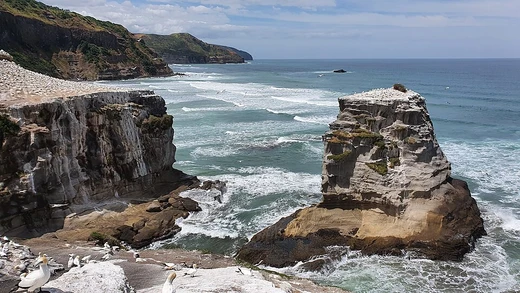
Hvitserkur
A basalt stack shaped like a dragon, reinforced by concrete.

Hvítserkur is a 15 m high basalt stack along the eastern shore of the Vatnsnes peninsula in northwest Iceland. It is notable for its dragon-like appearance, reinforced concrete base, and its status as a major tourist attraction, as well as its geological significance as a well-preserved early Miocene ignimbrite.
- height
- 15 m
- location
- Eastern shore of Vatnsnes peninsula, northwest Iceland
- type
- Basalt stack / ignimbrite
- age
- Early Miocene (about 13–12 million years ago)
- geological formation
- Hvítserkur ignimbrite, a caldera-fill pyroclastic flow
- known_for
- Dragon-like appearance, concrete reinforcement, and iconic tourism site
Lore & Background
Local tradition holds that Hvítserkur is the petrified remains of a troll that tried to destroy the nearby monastery at Þingeyrar and was turned to stone by the rising sun. In the mid-20th century, farmers concerned that the sea-eroded 'troll' might topple reinforced its base with concrete, a gesture born as much of practical care as of cultural attachment. Today Hvítserkur attracts large numbers of visitors, but the lack of marked paths has led to trampling of nearby bird-nesting sites and seal haul-outs on the adjacent gravelbanks. This has sparked debate among landowners, local authorities and conservationists over how to balance free access, visitor safety and wildlife protection—an issue made more pressing by the rock's iconic status in Icelandic tourism. The rock has two holes at the base, which give it the appearance of a dragon that is drinking. The base of the stack has been reinforced with concrete to protect its foundations from the sea.
Reader's Guide
Hvítserkur's significance lies in its dual identity as both a geological landmark and a cultural icon. Geologically, it is part of the Hvítserkur ignimbrite, a caldera-fill pyroclastic flow from the early Miocene (about 13–12 million years ago), making it one of the oldest well-preserved silicic products in Iceland. The ignimbrite is traversed by basaltic dikes and overlain by hyaloclastites and pillow-lava breccias, indicating a complex volcanic history involving a shallow lake within a trapdoor-style collapse caldera. The site provides valuable data for understanding felsic magma generation in a dominantly basaltic setting. Culturally, the stack is embedded in local folklore as a petrified troll, and its concrete reinforcement in the mid-20th century reflects both practical erosion control and cultural attachment. Today, it is a major tourist attraction, but the lack of marked paths has created tensions between visitor access and wildlife protection, particularly for bird-nesting sites and seal haul-outs. This ongoing debate highlights the challenges of managing iconic natural sites in Iceland.
Did You Know?
- Hvítserkur has two holes at its base that give it the appearance of a dragon drinking.
- Its base was reinforced with concrete in the mid-20th century to prevent it from toppling due to sea erosion.
- The Hvítserkur ignimbrite is one of the oldest well-preserved silicic products in Iceland, dating to about 13–12 million years ago.
- The rock is associated with a local legend of a troll turned to stone by the rising sun.
Frequently Asked Questions
What is Hvitserkur?
Hvitserkur is a tall sea stack rising from the coast of northwest Iceland, standing roughly 15 metres above the waterline. It is one of the most recognisable natural landmarks in the region and a popular stop for visitors exploring the Vatnsnes peninsula.
Where exactly can you find Hvitserkur?
It sits along the eastern shoreline of the Vatnsnes peninsula, in the northwest corner of Iceland. The stack is visible from the coast and serves as a well-known reference point for both locals and tourists in that area.
Why does Hvitserkur look the way it does?
Millions of years of coastal erosion have carved the basalt into a silhouette that many people compare to a dragon's head or a crouching creature. That striking, almost mythical shape is a major reason it became such an iconic photo spot.
How old is Hvitserkur and what is it made of?
The rock dates back to the early Miocene, roughly 12 to 13 million years ago, and formed from a pyroclastic flow that filled a volcanic caldera. Geologists classify it as a well-preserved ignimbrite, making it a notable example of that type of volcanic deposit in Iceland.
Why does Hvitserkur have a concrete base?
Engineers added a reinforced concrete foundation to stabilise the lower portion of the stack and slow coastal erosion that was threatening to undermine its footing. The intervention was designed to preserve the landmark so it remains visible to future visitors.
More in Coastal And Marine Features 1-24
Spotted an error? Know more?
This is a living reference — every entry is fact-audited, and reader corrections feed straight into our audit queue. Suggest an edit · See this site's audit record